Lori Barton
Director, Client and Partner Success, Affinity Solutions
Travel marketers have more dashboards than ever. More channels, more signals, more attribution models. And yet most teams still can’t answer a simple question clearly: Did this actually move the business?
The problem isn’t effort. It’s the data feeding the measurement, and a measurement model that was never built for travel.
Travel decisions unfold over weeks, across devices, channels, and household conversations. A traveler sees your ad on a sports website and keeps scrolling. Three weeks later, they book a trip on their cellphone through a third-party travel agency. They then spend $4,000 at the destination you helped them discover. Your campaign worked. Your measurement system has no record of any of it.
Campaign Measurement Fails Travel on Two Fronts
Campaign measurement was built for a simpler purchase journey: define a flight window, run ads, measure what happened, report campaign success. That works for categories with short, clean purchase cycles. Travel isn’t one of them.
The booking is often just the beginning. Destination spend on hotels, dining, and experiences can dwarf the cost of the flight itself. None of that downstream spending falls within the campaign window, so traditional measurement misses it entirely. And the signals most teams optimize toward—clicks, impressions, modeled conversions—wouldn’t capture it even with a longer window.
The result: travel marketers are optimizing against a fraction of the signal that actually matters, then presenting that fraction to a CFO who wants to know if the business moved. Running that same measurement continuously doesn’t fix it. Continuous measurement of the wrong signal is detrimental to your budget and strategy.
Continuously Refreshed Purchase Data. Flexible Measurement Windows.
Extending the window alone doesn’t help if the underlying signal is still incomplete. The conversation changes when you pair a flexible measurement window with a verified one: purchase data that refreshes continuously. This combination strengthens what you’re measuring, and a flexible window means travel’s long, multi-channel purchase journey isn’t forced into a flight window it was never built for.
When both are true, the questions you can ask change entirely. You stop asking “did this campaign work?” and start asking what your CFO actually cares about:
- Did we drive incremental revenue?
- Which segments shifted their spending?
- Did existing customers spend more?
- Where are competitors gaining share we’re not seeing?
HOW AFFINITY SOLUTIONS CLOSES THE LOOP
The Data Difference
Fixing the measurement model is only half the problem. The other half is the data underneath it.
Most first-party data is brand-siloed. It tells you who bought your product but not where else they’re spending, which competitors they’re switching to, or what the category is doing when you’re not running campaigns. That’s not a measurement limitation. It’s a data limitation.
Our dataset captures daily consumer spending across brands, categories, and competitors, not just transactions tied to your product. Paired with an always-on measurement, your team isn’t just measuring your own performance continuously — it’s watching the full market move in real time.
Incrementality Without the Guesswork
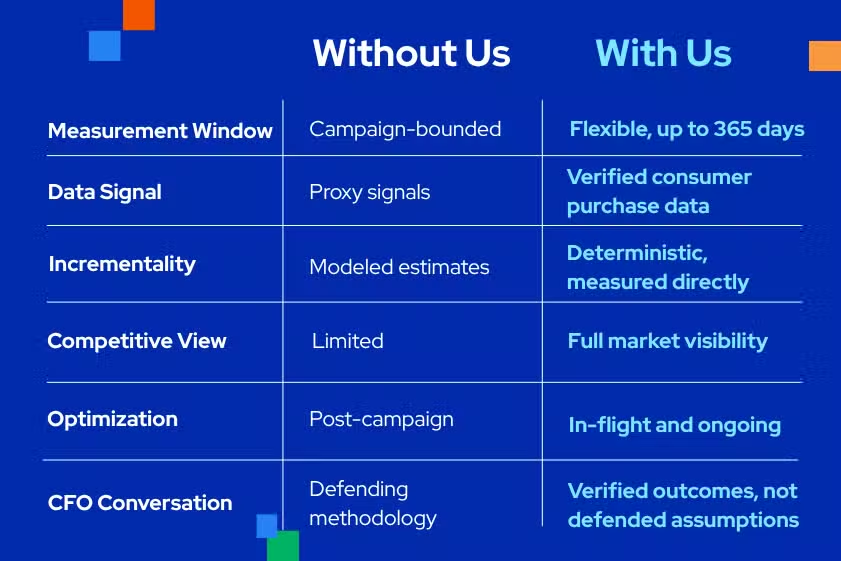
The core question for any travel marketer is whether a campaign created new demand or just reached people who were already planning to travel. We answer that by comparing exposed and unexposed audiences against verified transaction data, measuring campaign incrementality both in-flight and after it ends. As a result, teams can adjust while it still matters and prove total impact once the campaign is done. Our Consumer Purchase Lift solution is grounded in deterministic purchase data, not click-based or engagement proxies, just a direct line from media investment to real spend.
This goes beyond campaign measurement, too. Because our solution runs on a continuous view of verified consumer spending, you can see where share is shifting across your brand, your competitors, and the whole category, weeks before it surfaces in a quarterly report. You can see what drives organic demand when you’re not running campaigns, which audiences are active right now, and how your customers are spending in the months between flights.
That’s not a measurement advantage. That’s a strategic one.
Putting This Into Practice
In a post-campaign measurement model, insights are a postmortem function. The report arrives after the budget is gone, and decisions are always catching up to behavior that already happened — whether the data feeding it is clicks or verified consumer spending.
A flexible measurement window fixes the timing. Verified purchase data fixes the signal. Together, they change what your team can see, when they can see it, and what they can do about it.
There’s also a quieter benefit: confidence. Every campaign report built on proxies carries caveats. When measurement is continuous and grounded in verified spending, you stop defending methodology and start showing what happened — and shaping what comes next.
That’s a different conversation with your CFO. And it’s one most travel marketing teams aren’t equipped to have yet.