Welcome to The Receipt, a recurring market insights series from Affinity Solutions that takes a focused look at consumer spending trends drawn from over 150 million U.S. credit and debit cards representing 100 M+ consumers. Each edition examines a specific moment, category, or behavioral shift to translate verified purchase activity into actionable insights for brands, agencies, and media partners.
Every Labor Day, retailers run the same playbook: doorbusters, tent sales, last-chance emails. It’s easy to assume that’s where the weekend’s money goes. But when we looked at how consumers actually spent over Labor Day 2025, a different story emerged, one with real implications for how brands plan around this holiday.
We compared spending during the Labor Day weekend, August 29 through September 1, to a typical August weekend, using the same four-day window across the four prior weekends. That gave us a clean read on what actually changes when the calendar says holiday versus when it doesn’t.
The headline: consumers didn’t just shop more, they spent dramatically more per person, and most of that spend went toward experiences, not products.
Travel Spending Dominates Labor Day
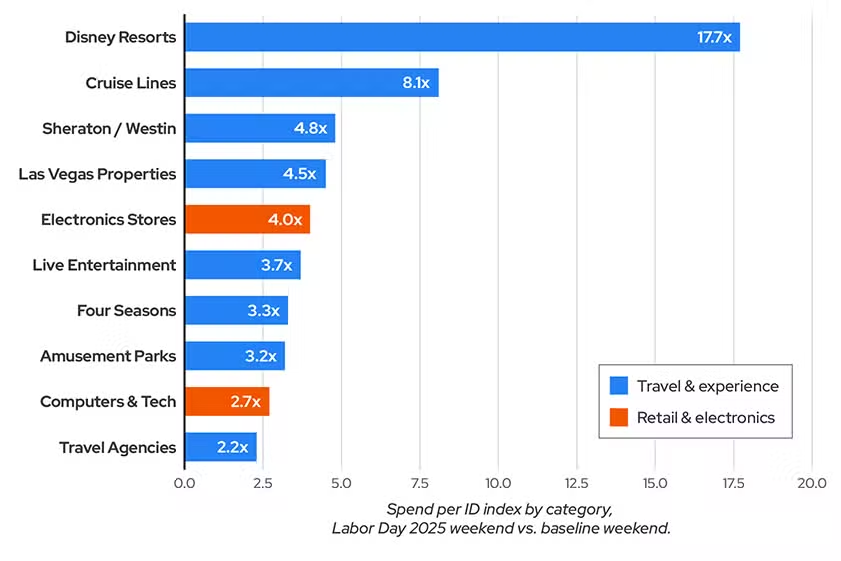
Disney Resorts saw spend per person climb to nearly eighteen times a typical August weekend. Cruise lines were up more than eight times. Travel agencies saw spending more than double. This isn’t a minor uptick, it’s a wholesale shift in how people use the holiday: as a reason to go somewhere, not just an excuse to buy something.
Hotel spending tells the same story. Sheraton and Westin properties rose roughly five times over baseline, Las Vegas properties climbed about four and a half times, and Four Seasons was up more than three times. People weren’t just booking a room. They were choosing leisure and destination brands, the kind of choice a three-day weekend makes possible.
Experience & Entertainment Spend Showed Similar Pattern
Amusement parks and live entertainment venues both saw spend rise more than three times over a typical weekend.
Taken together with travel, the picture is clear: Labor Day functions less like a retail holiday and more like a compressed vacation window. Three days people use to get away, unwind, and do something memorable before the fall season rush.
Retail Promotions Drive Selective High-Value Purchases
Retail is not absent from Labor Day; it just plays a supporting role. Electronics stores saw a fourfold lift, and computer and tech retailers were up nearly three times, proof that back-to-school timing and Labor Day sales events still move real volume in specific categories.
Here’s what actually changes for marketers: instead of guessing who might be in a travel mindset, they can build an audience out of people who verifiably spent on cruises, resorts, and hotels that weekend. That’s the real shift, not a sharper guess, but real behavior. And it’s exactly why treating the whole weekend as one shopping moment costs marketers the biggest spender on the field. The experience buyer never gets targeted as an experience buyer, just filed under a generic Labor Day list alongside everyone else.
What This Means for Marketers
For travel and hospitality brands, Labor Day is peak demand and deserves to be treated as its own moment rather than folded into general holiday promotions. For entertainment and leisure brands, it’s a chance to reach people who have already decided to spend on an experience, not to convince them to spend at all.
Retail and electronics brands have a sharper decision to make. A television or a laptop discounted for the weekend is a pure deal purchase, and a straightforward promotional message still works there. But a camera, a set of luggage, or noise-cancelling headphones is a different case: those products live inside the travel occasion, and framing them around the trip will likely outperform framing them around the discount. The split isn’t retail versus travel, it’s whether the product itself is part of the getaway or just something on sale.
For marketers, the real takeaway is about audience precision. A generic Labor Day campaign, one that assumes everyone is a deal seeker, misses most of what actually happened over the weekend. The brands that get the most out of the holiday will be the ones that can tell the difference between a promotional shopper and an experience seeker, and build campaigns that speak to each on its own terms.
That kind of distinction is exactly what verified consumer spending data makes possible: not just knowing that people spent more, but knowing who spent, where, and why, so audiences can be built around actual behavior instead of assumptions about what a holiday weekend is supposed to look like.
Let Our Consumer Purchase Audiences Find Your Next Buyer.