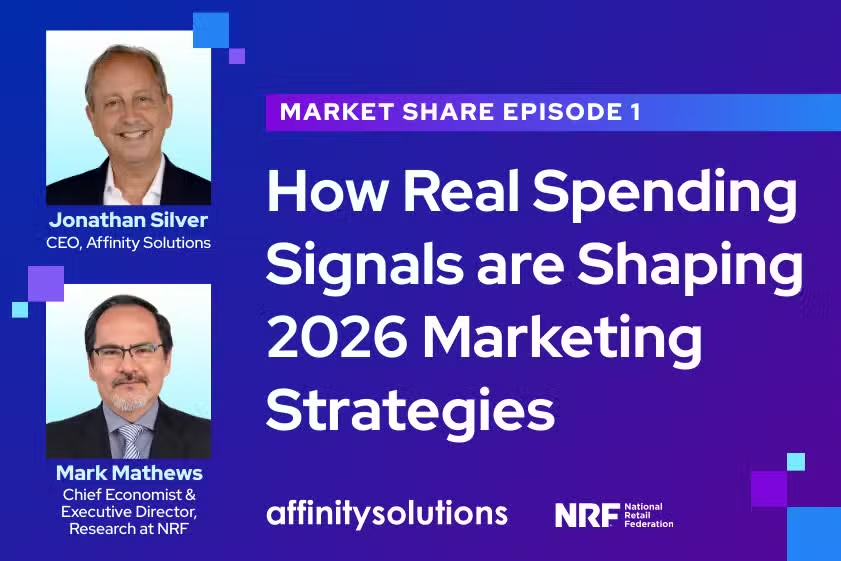
Market Share is a new series featuring Mark Mathews, Chief Economist and Executive Director of Research at the National Retail Federation (NRF), and Jonathan Silver, CEO of Affinity Solutions. Together, they unpack the consumer trends retail and QSR marketers need to know— and reveal how real purchase data—not surveys or proxies—can transform campaign planning, activation, and measurement.
Our first installment, How Real Spending Signals Are Shaping 2026 Marketing Strategies, explores the critical role Affinity Solutions’ real, permissioned purchase data plays in powering insights for CNBC and the National Retail Federation, and how advertisers can use these insights to inform smarter strategies in the year ahead.
________________________________________________________________________________________________________________________________
Q1: How is economic volatility reshaping retail strategies and which indicators matter most for navigating uncertainty?
MM: Retailers need to recognize the limits of traditional government and survey data. Declining survey response rates and shrinking sample sizes make these numbers increasingly unreliable. Government data often requires months of revisions, amplifying uncertainty. That’s why the CNBC/NRF Retail Monitor powered by Affinity Solutions is fantastic. It’s an incredibly deep data set that gives you a perspective on how the consumer is behaving, giving businesses the opportunity to see what’s going on a little bit earlier, and to adjust what they’re doing.
Based on 150 million debit and credit cards representing over 95 million consumers, Affinity Solutions consistently provides high-quality, timely, and comprehensive transaction data without post-release revisions, even during disruptions.
JS: Advertisers can’t afford to wait for delayed macro signals. Retailers often plan inventory 6–9 months ahead, so timely consumer signals matter and waiting means wasted spend. Real-time deterministic data eliminates uncertainty and allows advertisers to understand how consumers are actually spending on a very granular level – by region, store trade area, age, income, and even across competitors. This enables immediate action, so advertisers can quickly assess campaign performance, optimize in-flight, and reduce media waste.
Consumers are spending based on their wallets, not their psyche. Advertisers should focus on actual consumer spending rather than modeled or survey-based proxies. Real-time purchase data is the most reliable signal for making advertising investment decisions.
Q2: Brands are planning 2026 budgets. If consumer sentiment remains weak but spending stays strong, what should they prioritize?
MM: Media narratives – swirl around tariffs, inflation, SNAP benefits – create fear, but actual spend patterns tell a more accurate story. Behavioral shifts include growth in off-price formats, trading down to private labels, and increased promotional sensitivity. Consumers are “stretching the dollar,” changing basket composition and retailer choice even if total spend is stable.
We’re in a K-shaped economy: high-income consumers are driving spending growth, while lower-income households pull back. Luxury and premium segments remain resilient, while value segments feel pressure.
JS: Building on Mark’s point about the disconnect between sentiment and spending, advertisers need to focus on what consumers are actually doing—not what they say they feel. Income remains the strongest driver of behavior; even a 20% portfolio drop may not change affluent spending patterns. At the same time, omni-channel habits like buy online and purchase in store (BOPIS) and phone-assisted decisions are converging, which means segmentation can’t be static. It needs to be updated weekly to reflect real-world shifts.
To turn these insights into action, advertisers should ask:
- Are high- and low-income shoppers behaving differently—and am I adjusting for it?
- Which segments are spending more right now—and am I showing up for them?
- Am I segmenting beyond income to include geography, category spend, and recency/frequency?
Real-time purchase data reveals that consumers are grocery shopping more strategically—visiting multiple stores, using coupons, and prioritizing deals. Discount chains like Aldi are gaining share, with visits up over 7% year-over-year, while restaurants such as McDonald’s and Applebee’s are seeing strain among low-income shoppers. For advertisers, this means leaning into value messaging for price-sensitive segments while testing full-price strategies for wealthier shoppers. Brands like Levi’s and Ralph Lauren are successfully maintaining full-price positioning for resilient high-income consumers, while restaurants face menu trade-downs and skipped visits among lower-income diners.
But advertisers can’t just observe these trends—they need to act on them in real time by moving beyond traditional segmentation and embracing dynamic approaches. AI-driven segmentation and in-flight optimization aren’t optional anymore—they’re table stakes for staying relevant in a fragmented, fast-moving market.
By continuously updating audience profiles and adjusting campaigns mid-flight, advertisers can ensure they’re showing up for the right segments at the right moment—whether that’s affluent shoppers maintaining full-price habits or value-seekers trading down and chasing deals.
Q3: How can advertisers use these insights to prepare for 2026?
MM: Expect continued resilience among high-income earners. Premium categories may maintain pricing power, while essential categories should plan strategic promotions to attract price-conscious shoppers.
JS: Real-time, permissioned purchase data powers the entire marketing lifecycle-from planning and targeting to measurement and optimization. It enables advertisers to:
- Identify growth opportunities and competitive openings
- Act fast and adjust targeting, messaging, and media in the moment
- Reduce waste and capture share before competitors do
AI powered by high-quality purchase data will play a significant role in predicting future behavior, identifying opportunity segments, and driving next-best actions.
Check out more insights from the CNBC/NRF Retail Monitor powered by Affinity Solutions and be sure to keep an eye out for the next installment of Market Share.