A conversation with Marc Zagorski and Jon Watts
Attention to Retail was built around a simple premise: the forces shaping retail, marketing and measurement are changing rapidly, and the industry must evolve alongside them.
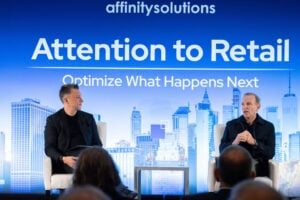
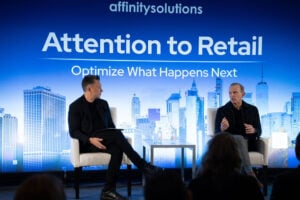
Many of the day’s discussions focused less on today’s realities and more on tomorrow’s implications. Few conversations captured that spirit more clearly than a discussion between DoubleVerify CEO Mark Zagorski and CIMM Managing Director Jon Watts, which examined how AI is poised to reshape the future of measurement.
For decades, advertising measurement operated on a relatively simple distinction: people buy things; bots don’t. Automated traffic was something to identify and filter out, while measurement focused on understanding real consumer behavior. But as AI agents become more capable of researching products, comparing options, and eventually making purchases on a consumer’s behalf, the line between human and machine activity is becoming harder to define.
That emerging reality became the foundation for a broader discussion about trust, independent measurement, and how the industry may need to rethink what it validates, measures, and values in an AI-driven future.
Trust May Be Advertising’s Most Important Currency
The industry has spent years debating metrics, currencies and attribution models, but Zagorski suggested the conversation may be missing something more fundamental: trust.
Trust between buyers and sellers. Trust in the data guiding decisions. Trust from consumers themselves.
Despite significant advances in technology and the sheer volume of information available to marketers, Zagorski argued that confidence in how that information is collected, measured, and used has not necessarily kept pace. That is one reason independent measurement remains so important.
As major platforms continue to play an outsized role in the media ecosystem, advertisers need an objective view of performance that extends beyond the companies selling the media. Independent measurement helps provide that perspective, creating accountability and credibility across increasingly complex advertising environments.
Trust, however, is not built on independence alone. Scale matters as well. Advertisers and publishers need confidence that the metrics they rely on will be broadly accepted and durable over time. Zagorski suggested that reality could continue driving consolidation among larger measurement providers, while still creating opportunities for niche players built around emerging technologies and datasets.

Measurement Has to Connect to What Matters
The conversation also addressed a challenge facing nearly every marketing organization today: proving impact. Trust in measurement only goes so far if marketers can’t connect those measurements to meaningful business results.
For Zagorski, measurement becomes significantly more valuable when it can connect to an outcome that marketers actually care about. Metrics that cannot demonstrate a meaningful connection to business results will inevitably face greater scrutiny.
At the same time, observing a purchase after an ad exposure does not necessarily prove causation, and that is where measurement has an opportunity to evolve.
Rather than focusing exclusively on which touchpoint deserves credit, marketers should be working to understand what actually influenced consumer behavior. Attention signals, context, publisher environments, and transaction data all contribute to that picture.
The goal is not simply assigning attribution. It’s to understand what changed consumer behavior in the first place.
As marketing leaders face increasing pressure to justify investments, that distinction becomes more important.

What Happens When a Bot Is Actually a Customer?
The most forward-looking part of the discussion centered on a question that would have sounded far-fetched only a few years ago: What if a bot is actually your customer?
Verification systems have historically been trained to identify and eliminate automated activity. Automated traffic could mimic engagement, but it did not represent genuine customer intent.
AI agents are starting to blur that line.
A consumer may soon ask an AI agent to research products, compare options, or even complete a purchase on their behalf. In that world, an automated interaction with a retailer or advertiser might represent a real prospective customer rather than fraudulent activity, creating a new challenge for the measurement industry.
How do advertisers determine whether an agent is legitimate? Who does it represent? And how should those interactions be valued?
Zagorski described this emerging challenge as “agentic credibility.” Just as the industry developed systems to verify impressions and identify invalid traffic, it may need a new framework to authenticate commercial agents and distinguish legitimate consumer representation from fraud or manipulation.
AI could also make measurement easier for marketers to navigate.
Zagorski pointed to the growing ability of conversational AI to help marketers interrogate complex datasets, identify meaningful changes, and surface insights without manually working through numerous dashboards. The underlying data doesn’t disappear, but AI can help marketers find the signal faster.
Building Measurement for What Comes Next
What made the conversation compelling wasn’t any single prediction about AI or measurement. It was the recognition that technologies often viewed as separate trends are quickly converging.
As AI becomes more involved in how consumers discover, evaluate and purchase products, the lines between human and machine activity will become harder to distinguish. That shift challenges some of the foundations on which today’s measurement systems were built and raises new questions about how legitimacy, performance and value should be assessed.
The answers are still emerging. But as Zagorski and Watts discussed, the industry’s future may depend less on measuring more signals and more on understanding which signals actually matter.
If AI continues to blur the boundaries between human and machine decision-making, the next challenge won’t be collecting more data. It will be determining what can be trusted.