What five years of transaction data reveal about America’s biggest commercial moment
Most marketers plan football’s biggest game around the game itself, but our consumer purchase insights say the opportunity extends beyond kickoff. Spending unfolds in three stages: Prep (the Saturday stock-up), Participate (game day, as more shoppers join in) and Celebrate (the occasion around the game). Underneath all three is a bigger story about who is spending, and how many.
To understand Big Game spending patterns, we analyzed five Big Games (2022–2026) using Affinity Solutions’ comprehensive transaction data. The percentages below compare spending around the event weekend with typical spending nearby in the same year, rather than comparing one year’s game with another. Saturday is compared with comparable Saturdays, Big Game Sunday with surrounding Sundays at the same stores, and the full weekend with nearby Saturday-Sunday pairs. These comparisons help distinguish the event pattern from broader growth and holiday-related variation.
Prep: Saturday Is the Stock-Up Day
Hosting-related retail peaks the day before kickoff. Saturday is the dominant prep day for five of six retailers we tracked, including Dollar Tree (+34.9%), grocery (+14.2%), Sam’s Club (+12.6%), Target (+9.5%) and Walmart (+9.1%). Costco is the exception, peaking Friday at +11.2%.
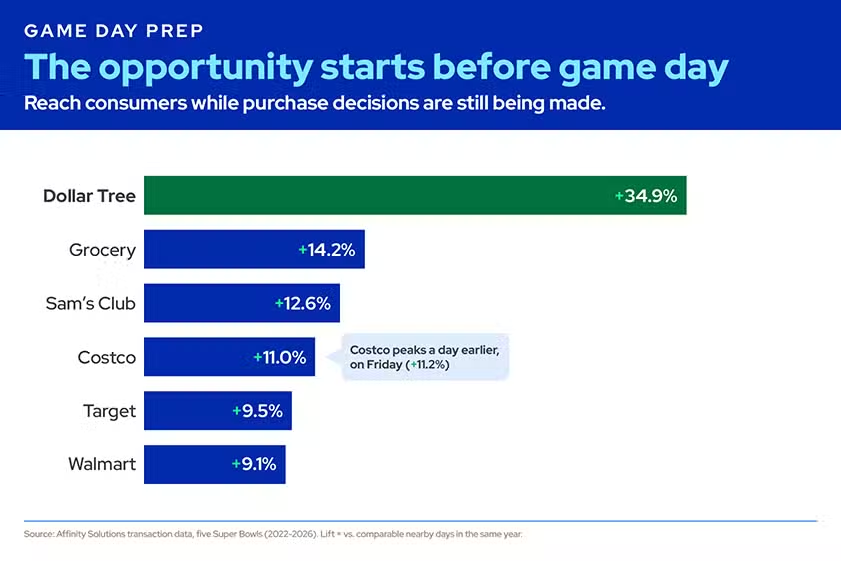
Dollar Tree’s median weekend spend lift of +32.6% makes party prep a meaningful marketing opportunity. The pattern is consistent with shoppers picking up snacks, supplies, décor, and last-minute hosting essentials. For marketers, the opportunity is to connect with the hosting mission, not just the game itself.
Participate: Game Day Brings More Shoppers In
Online gambling tells the clearest game-day participation story. Its median Sunday spend lift was +93.1%, with spending above typical levels in all five years. The increase in shoppers was even more pronounced, ranging from +380% to +455% each year (2022–2026). For marketers, the distinction matters: the opportunity is not just how much people spend, but how many take part.
Pizza-focused brands (+42.4%) and wing-focused brands (+40.9%) both win Sunday. Pizza is a game-day-only spike (-0.8% across the full weekend), while wings hold up better across the weekend (+5.6%).
*These figures track spending at pizza- and wing-focused brands, not individual menu items. Because many pizza chains also sell wings, a host may order both from one place. Read the results together, not as a pizza-versus-wings comparison.
Celebrate: The Occasion Continues Beyond the Game
Alcohol retail rises every single year, with a +16.5% median weekend spend lift and shopper lift of +68% to +78% each year. Bars/taverns (+2.7%) and rideshare (+3.2%) also show increases in weekend spending. While smaller than the alcohol-retail increase, they add context to the social occasion, suggesting the spending pattern extends beyond stocking up at home. Directionally, liquor and grocery lift skews toward Gen X, Boomers, women and $80K+ households, while variety stores skew toward Millennials and women.
The Bigger Story: More Shoppers, Not Bigger Baskets
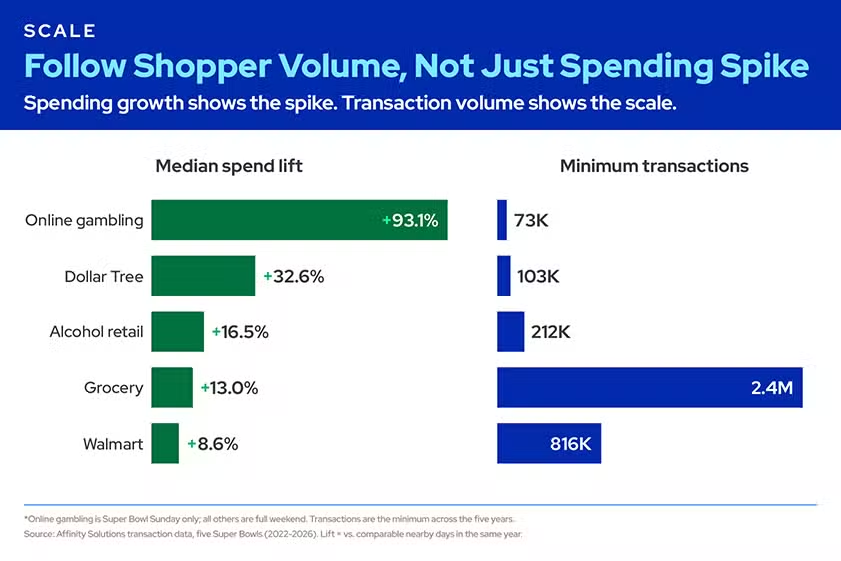
Across several categories, the Big Game lifts participation more than individual spending: shopper counts, transactions, and spend rise, while spend per shopper often falls. Online gambling is the clearest example, with shopper growth far outpacing spend intensity. Alcohol follows the same pattern, with shopper growth outpacing spend growth.
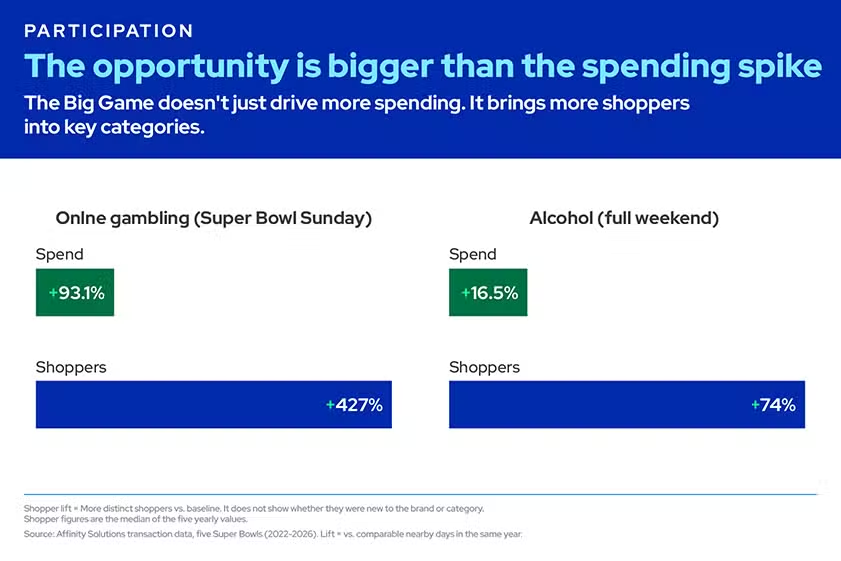
The Big Game is a participation event, not just a higher spend-per-shopper event; higher shopper counts do not, on their own, establish that those shoppers are new to a category or brand.
For marketers, the distinction changes what to measure. A sales increase in your own customer data does not, by itself, explain whether growth came from new buyers or existing customers spending more. It also does not show whether a competitor captured the Saturday prep trip. First-party data explains activity within your business; category-wide transaction data adds the competitive context needed to understand the broader spending patterns.
Grocery shows why scale matters. Its lift (+14.2% on Saturday, +13.0% across the weekend) is more modest, but its observed transaction volume, even in its lowest year, is substantially larger than at Dollar Tree or Walmart, making grocery one of the largest-scale Big Game behaviors in the data. That scale matters: even a moderate percentage increase across many transactions can represent a meaningful spending opportunity. Walmart is similar: +9.1% on Saturday and +8.6% across the weekend. For marketers, moderate lift at massive scale can still be a major activation opportunity.
Score Big on the Big Game
– Prep: Plan for Saturday, not just Sunday. Hosting-related retail peaks the day before kickoff, so reach shoppers while purchase decisions are still being made.
– Participate: Treat game day as a mass-participation moment, and measure how many shoppers take part, not just how much each one spends.
– Celebrate: Keep the plan going across the weekend. Alcohol, bars and rideshare show the occasion extends beyond the game itself.
– The Bigger Story: Use category-wide purchase insights to see whether growth is coming from new shoppers, and whether competitors captured the demand.
Together, those perspectives give marketers a clearer basis for deciding when to engage consumers and what to measure.
Planning your next major marketing moment? Talk to our team about using category-wide purchase insights to understand when consumers spend, how participation changes and where competitors capture demand.
*Note: This analysis focuses on categories with a clear Big Game spending pattern. We excluded categories where overlapping occasions, including Valentine’s Day, made interpretation less reliable. The comparisons describe spending around the game; they do not establish that the game alone caused every change.