Proving return on ad spend (ROAS) is one of the biggest challenges for quick-service restaurants (QSRs) given the pervasive fragmentation across the media landscape. Traditional metrics like reach and frequency tell part of the story—but they don’t answer the most critical question: Did that ad drive a purchase?
For QSR marketers, closing the gap between the screen and the sandwich is no longer optional. It’s the key to turning TV from a brand awareness tool into a measurable performance channel.
Connecting Media Spend to Real-World Sales
As consumer attention splinters across platforms, QSR brands need more than impressions and ratings. They need to know:
- Are ads reinforcing loyalty among existing customers?
- Are they winning diners away from competitors?
- What’s the optimal frequency to maximize conversions without wasting spend?
- Did my ad drive more purchases?
Without answers, media budgets risk becoming cost centers instead of growth engines.
Advanced measurement strategies now make it possible to link ad exposure directly to purchase behavior. By integrating viewership data with real-world transaction insights, brands can:
- Attribute sales to specific campaigns and networks
- Identify conquesting opportunities among competitor audiences
- Discover the “sweet spot” for ad frequency to avoid diminishing returns
This shift from proxy metrics to purchase-based attribution moves marketing from guesswork to proven performance.
Proof It Works: Affinity Solutions and iSpot Link Ad Exposures to Purchases Proving 46% Sales Lift for a QSR Brand
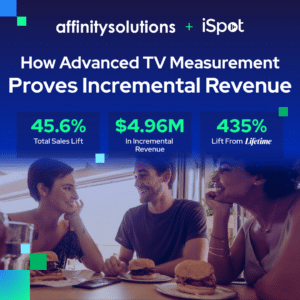
Because Affinity Solutions delivers actual, deterministic purchase data—not proxies or modeled guesses—brands can confidently connect every ad exposure to real-world sales. For a recent campaign, a QSR brand leveraged Affinity Solutions’ real-world credit card insights and iSpot’s viewership data to close the loop between ad exposure and purchase behavior. The outcome?
Clear, measurable ROAS: 45.6% total sales lift amounting to nearly $5 million in incremental revenue
This approach further revealed insights critical for driving growth:
- Revealing Competitive Share: A significant lift among the competitive “Chick-fil-A Shopper” segment revealed an opportunity to convert customers from rival brands.
- Identifying Top-Performing Network: The Lifetime network emerged as a top performer, driving a 435.81% lift.
- Understanding Optimal Ad Frequency: Two to three ads per household drove the highest lift (96.98%).
Advanced measurement is no longer a nice-to-have—it’s the key to transforming TV from a passive awareness channel into a proven revenue driver for QSR brands. But success requires more than just data; it demands real-time, high-quality consumer purchase insights that can connect the dots from impressions to actual sales. Only then can marketers draw a straight line from ad exposure to measurable outcomes and move beyond guesswork to growth.
We are what happens when attention turns into action, enabling QSR brands to transform TV from a passive awareness play into a proven revenue engine.
Ready to see how purchase-based attribution can unlock your next campaign’s potential? Learn more about our Consumer Purchase Lift solution by visiting affinity.solutions/consumer-purchase-lift.